STEM Education's Impact on Nigerian Children
Education, STEM, Nigeria, Niger Delta Innovate
What Is STEM Education and Why It Matters for Nigerian Children
Across Nigeria, and especially in the Niger Delta, STEM education is no longer a “nice to have” - it is fast becoming the baseline for future jobs, innovation, and economic stability. Understanding what STEM really means, why it is lagging, and how organisations like Niger Delta Innovate (NDI) are changing the story can help parents, schools, and communities act now rather than later.

What Does STEM Actually Stand For?
STEM stands for Science, Technology, Engineering, and Mathematics - but in practice, it is less about four separate subjects and more about how they are woven together. True STEM education is built on doing, not just memorising. Instead of learning formulas or theories in isolation, students are asked to build, test, fail, and try again.
It is the difference between reading about a circuit and actually wiring one; between studying a textbook diagram of a robot and coding one to move across a room. In a strong STEM classroom, children learn to ask questions, collect data, collaborate with peers, and use technology to solve problems they have never seen before. These are the same skills that power modern careers in everything from health tech and agriculture to fintech and renewable energy.
For Nigerian children, this shift matters more than it might first appear. Reports on Nigeria’s digital landscape show that while there are over 100 million internet users, more than half the population still lacks reliable access and many young people have limited digital skills. As the World Bank and other partners note, this weakens future earnings and productivity in a country where over 60% of the population is under 25. In other words, the jobs their generation will compete for, locally and globally, increasingly reward the ability to solve unfamiliar problems with technology, not just recall facts.
Why STEM Education Is Falling Behind in Nigeria
Despite recent policy moves from the House of Representatives and agencies such as NASENI, TETFUND, and the National Universities Commission to strengthen STEM, the reality in many classrooms still looks very different. Across much of Nigeria, and especially in regions like the Niger Delta, STEM education leans heavily on theory and exam preparation rather than practice and creativity.
Many secondary schools have no functioning science labs, let alone robotics kits, computers, or reliable internet. A 2026 policy review found that only about one-third of public schools have functional ICT labs, and nearly 78% of young people lack foundational digital literacy. Teachers themselves are often under-equipped: fewer than half have basic ICT competence, and digital teaching methods are rarely part of their training or evaluation. Instead of guiding students through projects, many teachers are forced to focus on covering an overloaded syllabus with limited resources.
The result is a generation of bright students who can pass exams on paper but have never built anything, debugged anything, or presented a real solution to a real problem - the exact skills universities and employers are now screening for. Girls are particularly affected: recent research shows that female students remain underrepresented in STEM at secondary level, and that strong institutional support and an inclusive school climate are critical to changing this pattern.
The Real-World Cost of a Widening Skills Gap
This is not an abstract concern. As Nigeria’s digital economy grows, the demand for coders, data analysts, engineers, and technicians is rising quickly. Yet, the supply of job-ready talent is not keeping pace, especially outside major hubs like Lagos and Abuja. A recent analysis estimates that digital skills gaps cost Nigeria around USD 11 billion every year in lost growth and missed opportunities. At the same time, the NNPC Foundation has warned that roughly 18.4 million Nigerian children still lack access to any form of STEM education.
Students in the Niger Delta, despite immense natural talent and curiosity, are too often shut out of these opportunities simply because they were never given the tools, mentorship, or exposure. Every year this gap persists, more young people are pushed into underemployment or informal work, while local industries import skills that should have been homegrown. The mismatch is clear: employers struggle to find candidates with practical digital and technical skills, even as millions of young people are searching for meaningful work.

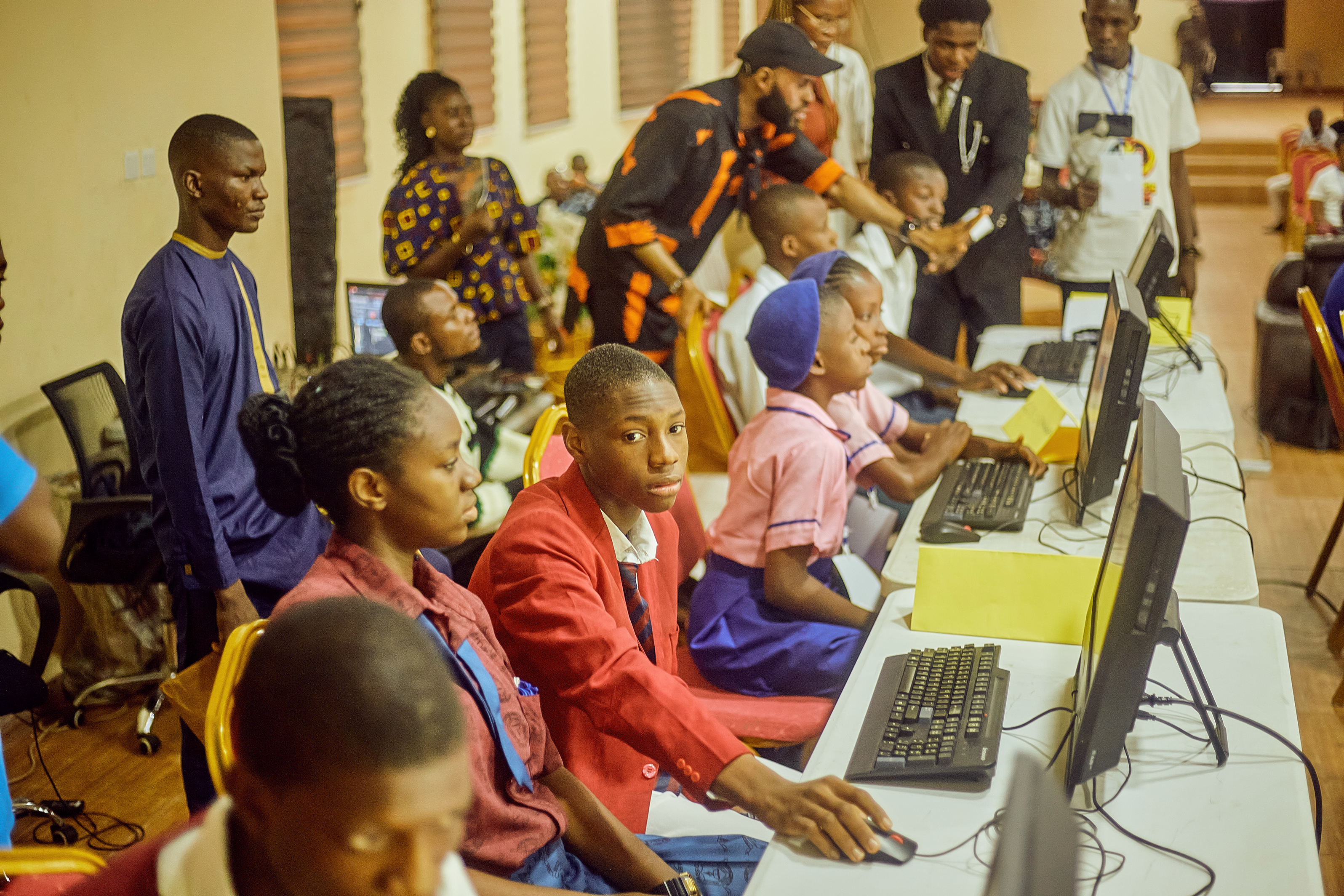
When students build real projects, STEM shifts from theory to opportunity.
For families, the cost shows up in limited career options and lower lifetime earnings. For communities, it means slower innovation and reduced capacity to solve local problems - from energy access and environmental management to healthcare and agriculture. For Nigeria as a whole, it represents a serious threat to long-term competitiveness in a world where technology underpins almost every sector.
How Niger Delta Innovate Is Closing the Gap
This is the exact problem Niger Delta Innovate (NDI) was created to solve. Rather than waiting for every school to be fully equipped, NDI is building practical, scalable pathways that bring hands-on STEM directly into classrooms across Rivers State and the wider Niger Delta.
At the heart of this work is a Digital Technology curriculum aligned with the Nigerian Educational Research and Development Council (NERDC). This ensures that what students learn in NDI-supported programmes connects with national standards while still reflecting the realities of today’s technology-driven world. Lessons emphasise projects, collaboration, and problem-solving, not just note-taking and past questions.
NDI’s growing network of Technovation Clubs in robotics, coding, and data science turns this curriculum into lived experience. In these clubs, students design and program robots, build simple apps, explore data, and prepare for competitions and showcases. Learning happens in teams, guided by trained facilitators who encourage experimentation and resilience rather than fear of failure.
Powering all of this is Loop, NDI’s real-time learning and assessment platform. Loop allows teachers and mentors to track student progress, run interactive quizzes, and give instant feedback, turning phones, tablets, or school computers into tools for active learning rather than passive consumption. It also helps schools measure impact and identify where extra support is needed.
In July 2026, this work came to life at NDI’s maiden Robotics and STEM Fair. Students from partner schools showcased functional robots they had built and competed live in a STEM Quiz hosted on Loop. For many participants, it was their first time presenting a technology project on stage - and a powerful proof that, with the right tools and guidance, Niger Delta students can compete with the best anywhere. You can read the full recap of the event in our dedicated post on the NDI Robotics and STEM Fair 2026.
What Parents and Schools Can Do Today
You do not need a fully equipped robotics lab to start moving in the right direction. Small, consistent steps taken by parents, teachers, and school leaders can make a meaningful difference in how children experience STEM today and in the opportunities they can access tomorrow.
Encourage curiosity at home. Ask children how things work, let them help with simple repairs, explore science videos together, or try low-cost experiments using everyday materials. Curiosity is the foundation of STEM confidence.
Ask your child’s school about STEM clubs. Find out whether there are science, coding, or robotics clubs, and if there are not, ask what it would take to start one. Even a weekly after-school session can spark interest and build practical skills.
Leverage community programmes. Look for initiatives like NDI’s Technovation Clubs that bring structured, hands-on STEM learning within reach of public and private schools.
Champion teacher support. School leaders can prioritise training that helps teachers move from chalk-and-talk lessons to project-based STEM. Evidence from Nigerian classrooms shows that when teachers change their practice, student engagement and confidence follow quickly.
Stay informed about the bigger picture. National reports on Nigeria’s digital skills gap from organisations such as the World Bank and Nigeria’s National Bureau of Statistics underline just how urgent this issue is. Understanding these trends can help parents and schools plan beyond exams and think in terms of long-term skills.
The earlier a child gets hands-on with STEM, the more natural it becomes, and the more doors it opens down the line. Whether a student dreams of becoming an engineer, doctor, entrepreneur, or community leader, the ability to use data, technology, and critical thinking will shape how far they can go.
📌 Key Takeaway: STEM is not just for “science students.” It is a way of thinking and problem-solving that every Nigerian child needs, whatever path they choose.
Get Involved with Niger Delta Innovate
If you are a parent, teacher, or school administrator in the Niger Delta, you do not have to tackle this challenge alone. Niger Delta Innovate is actively partnering with schools to launch and sustain Technovation Clubs, integrate our Digital Technology curriculum, and use Loop to track real learning, not just test scores.
Want your school or child involved in NDI’s Technovation Clubs? Reach out to us today to learn how to get started. Together, we can ensure that children in the Niger Delta are not left behind in the global race for STEM and digital skills, but are equipped to lead, innovate, and build solutions for their communities and beyond.
